
To celebrate World Origami Days and honor Eric Joisel’s iconic seahorse design, picture a finely folded creature drifting in an imagined underwater realm. It’s no ordinary fish or typical origami piece; amid streamlined swimmers, the seahorse stands apart, upright and graceful, gently pushing against the tide. Like an origami artist coaxing life from a single sheet of paper, the seahorse’s subtle undulations create delicate, invisible currents that hold it steady, as if crafted by nature itself.
I. Crafting Stillness, Drifting with Grace
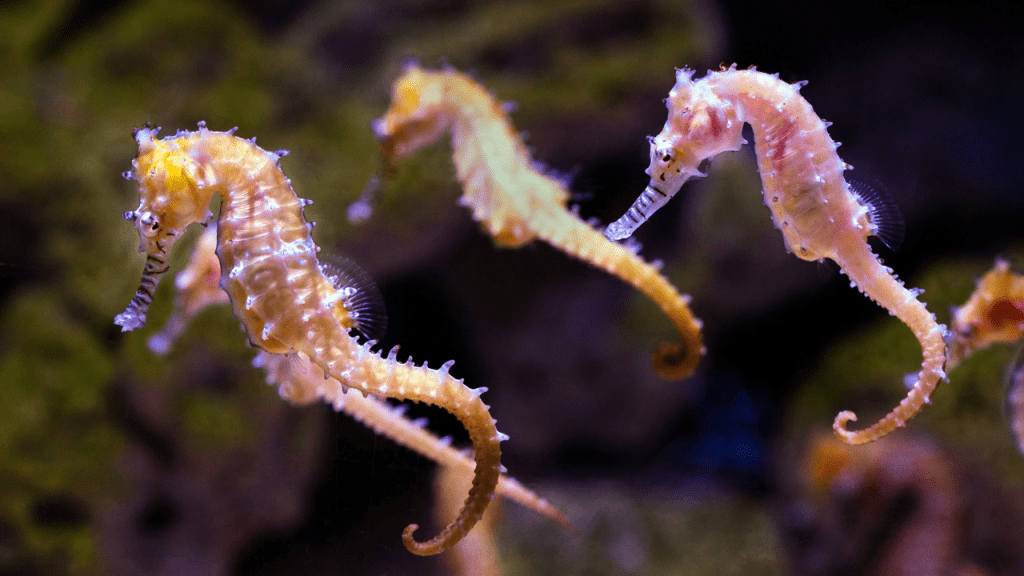
Every feature of the seahorse’s anatomy—from its slender body to its curling tail—supports a uniquely poised movement. Unlike sleek fish that slice through water, the seahorse floats like a balanced artwork, each fold and twist crafted for gentle hovering rather than speed. It glides almost imperceptibly, stirring hardly a ripple, blending so seamlessly into its surroundings it feels as though it belongs to the very fabric of the sea.
Aided by its internal swim bladder, the seahorse achieves a delicate equilibrium, allowing it to hover with minimal effort, buoyed by the water’s support. Its dorsal fin ripples like a ribbon across an invisible crease, guiding its calm, steady swimming. Unlike the razorfish—a fellow upright swimmer known for sharp, darting movements—the seahorse embodies a slower rhythm, appearing almost painted into place, gracefully poised within its watery world.
Its prehensile tail serves as a living anchor, wrapping around seagrass or coral to hold steady in shifting waters, much like a stabilizing crease in origami. This gentle grip counterbalances the surrounding currents, allowing the seahorse to hover like a hummingbird on water. Rather than thrusting forward, it glides in serene, effortless stability: a creature of quiet resilience, choosing balance over speed. Swimming at a low Reynolds number, the seahorse moves in a realm where water’s viscosity is more significant than inertia, interacting deeply with the surrounding currents to maintain its tranquil balance.
II. Paper Folds and Fluid Moves
For all its gentleness, the seahorse holds surprising agility. By shifting its angle, it transitions smoothly between hovering and darting forward. Just as a slight adjustment to an origami fold transforms a paper figure’s balance, the seahorse directs its path by finely tuning the rhythm of its dorsal fin.
The secret lies in the frequency and amplitude of the fin’s undulations. Faster, high-frequency waves create more force, while slower ripples allow gentle hovering. In pivot feeding, a quick head snap allows the seahorse to capture prey, much like adjusting a fold to gather momentum. With each movement, it’s as if the seahorse gains new depth and life, transforming angles into fluid grace, a living origami that moves in harmony with its surroundings.
III. Hidden Patterns in the Water’s Crease
The dorsal fin doesn’t only provide propulsion; it creates tiny vortices that shape the water around it, much like creases in a blueprint guiding an origami masterpiece. Each ripple forms powerful, swirling flows, shaping delicate patterns that stabilize or propel the seahorse. It’s as though the water itself folds, shifting and turning as it molds around the seahorse’s form.
With every undulation, these ripples extend outward, creating a hidden pattern as intricate as the folds in paper. Water flows backward and downward, driven by rhythmic, calculated motions, echoing an artist’s precise hand. These mini vortices create lift and stabilizing turbulence around the seahorse’s body, acting as an invisible cushion that allows it to remain still even as surrounding water moves. This rhythmic dance directs water backward and downward, stabilizing the seahorse with graceful, calculated motions. In this underwater ballet, every fold sculpts a subtle equilibrium between movement and balance.
Conclusion: The Art of Balance Below the Surface
The seahorse, a natural origami masterpiece, embodies fluid motion in its most intricate form. Like each crease in paper folding that transforms flatness into dimension, the seahorse’s form and movement are sculpted by water’s currents. In both paper and ocean, each fold, each tilt, tells a story of balance and elegance.
And what better way to connect with this art than by folding a paper seahorse yourself? Let each crease echo the subtle currents that shape the real creature, the hidden patterns that stabilize it against the tide. Could a single, fragile fold reveal the ocean’s secrets?
💧 Flow Check 💧
In the intricate dance of seahorse swimming, fluid dynamics principles reveal the art behind every tilt and undulation:
- Hydrodynamic Forces: The seahorse’s dorsal fin creates precise hydrodynamic forces, allowing it to hover or pivot with graceful control.
- Vortex Creation: Small but powerful vortices formed by fin movements stabilize and guide the seahorse’s motion, like miniature “folds” in the water.
- Buoyancy and Stability: Its upright posture and prehensile tail balance the seahorse in place, demonstrating the subtle mastery of buoyancy and flow.
🌊 Rogue Wave 🌊
Dive into the art of fluid motion like a seahorse in the sea! Here are some challenges to keep the currents flowing:
- Try moving with grace today, making each step as intentional and smooth as a seahorse’s fin ripple. Notice the micro-currents you create around you!
- Fold your own paper seahorse, and see if each crease brings a new layer of appreciation for underwater fluid flows.
- Can you think of a way to stay “anchored” yet flexible, just like the seahorse’s trusty tail?
Dive Deeper
Social Currents:
- World Origami Days 2024 – Day 11. Seahorse
- Erin Blakemore (2024, March 30). Sea horse research gets a boost from volunteer citizen-scientists. The Washington Post.
- Kathleen Massara (2019, November 2022). The Modern Life of Origami, an Art as Old as Paper. The New York Times.
- The Learning Network (2021, April 29). Origami in Space Engineering: Rediscovering the Meaning of Discovery. The New York Times.
- Richard Smith (2020, November 19). The secret world of pygmy seahorses, where males give birth – photo essay. The Guardian.
- Reuters (2016, December 16). Why do sea horses swim upright, look like horses and have male pregnancy? The Washington Post.
- Rachel Feltman (2014, August 7). Engineers are using origami to fold the robots of the future. The Washington Post.
- James Grant & Annabel Amos (2024, October 20). Crafting is ‘very important to my mental health’. BBC.
Fluid Dynamics:
- Li, X., Chen, G., Tang, Y., & Zhong, J. (2024). Hydrodynamic analysis of the upright swimming of seahorse. Physics of Fluids, 36(2).
- Gemmell, B. J., Sheng, J., & Buskey, E. J. (2013). Morphology of seahorse head hydrodynamically aids in capture of evasive prey. Nature communications, 4(1), 2840.
- Real Science (2022, September 24). The Insane Biology of: The Seahorse
Photo by David Clode on Unsplash.
This article was crafted with a touch of AI to bring fluid dynamics to life.

 Rogue Currents
Leave a comment